CPS Explained

At a glance: HebHomes’ Closed Panel System (CPS)—developed with Donaldson Timber Systems using Sigma® II—delivers lower U-values (≈0.13–0.15 W/m²K as standard), faster erection, and fewer follow-on trades than SIPs or standard timber frame. It uses hydrophobic recycled glass-wool blown fibre (no oil-based rigid foam), has BOPAS+ & BBA approvals with a 60-year assurance, and arrives ready for first-fix electrics.

  • Deeper wall (≈235 mm insulation zone) for superior performance and better architectural proportions.
  • Minimal cold bridging via double-stud geometry; OSB both sides, ventilated cavity outside.
  • Factory-fitted external breather membrane & airtightness detailing—no internal membrane to fit.
  • No insulated plasterboard needed to hit target U-values; less material, fewer trades.
  • Faster programme: typical HebHome reaches wind & weathertight in ~7 working days.
  • Stronger, stiffer racking performance and robust quality control.

CPS versus SIPs (in practice)

  • Thermal performance: CPS delivers ≈0.13–0.15 W/m²K as standard. A 150 mm SIP panel is commonly ~0.21 W/m²K; with extra internal layers some SIP builds reach ~0.16 W/m²K—still typically higher (worse) than CPS.
  • Fewer follow-on trades: CPS arrives with breather membrane & air layer resolved and a built-in service zone. SIPs usually need vapour control foil, internal service battens and often insulated plasterboard to match CPS U-values.
  • No oil-based rigid foam: CPS uses recycled glass-wool blown fibre (hydrophobic) rather than polyurethane/PIR cores typical in SIPs.
  • Adaptability on site: CPS is more forgiving for late changes and first-fix routing; SIP penetrations risk compromising the OSB/air layer.
  • Assurance & lending: CPS is BOPAS+ & BBA approved with a 60-year assurance, which lenders and valuers recognise for Modern Methods of Construction.
  • Crane Requirements: The CPS system, because of its weights, often requires a larger crane than SIP, making erection expensive or impractical in some locations.

How CPS is built

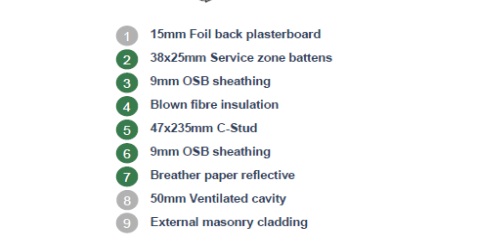
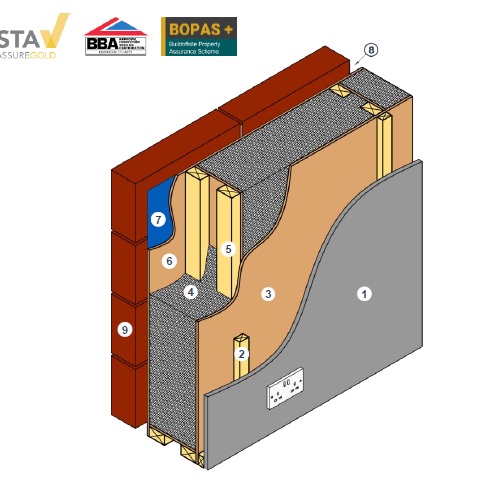
  • Double-stud Sigma® II frame with separated C-studs.
  • Blown fibre insulation filling the deep cavity (≈235 mm).
  • OSB sheathing both sides; factory-fitted external breather membrane.
  • Internal service zone & foil-backed plasterboard—no internal VCL install required.
  • External ventilated cavity and cladding (timber/render/metal/masonry).

Programme & site benefits

  • Rapid erection: trained crew typically achieves wind & weathertight in ~7 working days (type/season dependent).
  • Ready for first-fix electrics: service zone avoids chasing and preserves the air layer.
  • Less weather risk, less waste thanks to off-site manufacture and integrated membranes.

Common Questions

What does CPS stand for?

CPS stands for Closed Panel System—panels are delivered closed with insulation and sheathing factory-installed, improving speed, airtightness and quality.

What U-values does CPS achieve—and how does that compare to SIPs?

CPS typically achieves ≈0.13–0.15 W/m²K as standard. A 150 mm SIP panel is typically around ~0.21 W/m²K; with added internal insulation many SIP builds reach ~0.16 W/m²K. CPS usually outperforms SIPs without needing insulated plasterboard.

Does CPS use oil-based rigid foam?

No. CPS uses hydrophobic recycled glass-wool blown fibre insulation, avoiding the polyurethane/PIR rigid foam cores common in many SIPs.

Is an internal vapour control membrane required on site?

Not with CPS. The external breather/air layer is factory-fitted and the internal lining is designed so you don’t need to install an internal VCL on site.

Do I need insulated plasterboard with CPS?

No. CPS achieves its target U-values without insulated plasterboard, saving time, material and trades.

Is CPS stronger than SIPs?

CPS provides excellent racking strength and robust fixity via its double-stud/OSB build-up, with testing and certification under BOPAS+ and BBA.

How does CPS reduce cold-bridging?

The double-stud geometry separates inner/outer studs so timber does not form a continuous path through the insulation, dramatically minimising thermal bridges.

Is CPS mortgageable and warranty-friendly?

Yes. CPS is BOPAS+ & BBA approved with a 60-year assurance, recognised by major lenders and warranty providers.

Is CPS faster than SIPs overall?

In practice, yes. While SIP shells can go up quickly, they typically need more follow-on trades (VCL, service battens, insulated plasterboard) to hit target performance. CPS arrives closer to finished, so projects reach weathertight and first-fix faster. CPS will require a larger crane however. 

What is CPS? ›

CPS is a closed-panel timber frame system made off-site for rapid, high-quality assembly.
Learn more: Our Systems

What is SIP? ›

Structural Insulated Panels — engineered boards with insulation between, providing structure and thermal layer.
Learn more: Our Systems

What’s the difference between CPS and SIP? ›

Both deliver excellent performance. Choice depends on budget, detailing and lead time. We’ll recommend the best system for your project.
Compare: CPS vs SIP

Call to Action

Ready to Begin?

Exploring or planning? Define your budget, timeline, and site needs with us.

Discuss Your Project